
Flying open is the single most common power-killer in baseball. It looks like a timing problem. It feels like a strength problem. But it's a mechanics problem — and it's one that video analysis can identify in a single frame.
If your bat speed has dropped, you're pulling weak grounders, your coach keeps yelling "stay closed," and nothing you try seems to stick — this is the article you've been looking for. We're going to break down exactly what flying open is, why it destroys your kinematic sequence, why most hitters can't feel it happening in real time, and what the most effective fix actually looks like.
Early shoulder rotation — flying open — can reduce bat speed by up to 37%. That's not a slump. That's a mechanical leak that compounds every at-bat.
What Does "Flying Open" Actually Mean?
Flying open refers to the front shoulder rotating outward — away from the plate — too early in the swing. Specifically, the front shoulder pulls back and the chest turns toward the dugout or pitcher before the hitter's hips have had a chance to lead the rotation.
The result is a collapse of the entire kinematic chain. Instead of energy flowing from the ground up — hips, then torso, then shoulders, then arms, then bat — the upper body takes over and fires independently. The bat path gets dragged across the zone at an angle, producing:
- Weak grounders pulled to the pull side
- Topped balls with backspin instead of topspin drive
- Inability to hit the outside corner with any authority
- Inconsistent contact even when the timing feels right
- Loss of extension through the zone
Sound familiar? That's because this flaw is extraordinarily common — from youth leagues all the way to the collegiate level. And the reason it persists is not lack of effort. It's that most hitters cannot feel themselves doing it.
The Kinematic Sequence: Why Order Matters
Before understanding the fix, you need to understand what you're breaking. The kinematic sequence is the chain of body segments that fire in a specific order to generate maximum bat speed at contact. In elite hitters, it looks like this:
- Pelvis rotation initiates first — the hips open and pull the lower body into the zone
- Torso follows — a brief lag between hip and shoulder rotation creates torque, like a coiled spring
- Shoulder rotation fires next — powered by that stored torque, not independent muscle activation
- Arms and bat follow last — as the distal end of the chain, they travel fastest because the proximal segments did their job first
When you fly open, you collapse step 2. The shoulder fires at the same time as — or before — the hips. The torque window disappears. You're now swinging with your arms and upper body alone, generating maybe 60% of your potential power, producing that dragged bat path across the top of the ball.
Why You Can't Feel Yourself Flying Open
Here's the part coaches rarely explain clearly: the swing happens in under 150 milliseconds. That's faster than the human visual system can consciously process. Your proprioceptive feedback — the internal signals that tell your brain where your body is in space — simply cannot report back in time to inform mid-swing corrections.
This is why telling a hitter to "stay closed" or "use your hips" rarely works in isolation. They try. Their brain sends the instruction. But the movement pattern is already encoded — it fires faster than conscious thought can intervene.
What you feel when you fly open is often nothing. Or worse, you feel like you swung well, because the ball happened to be in the location where that broken path made contact. The feedback loop in your nervous system is lying to you.
Explicit instructions — "rotate your hips first," "keep your shoulder in" — engage the conscious motor system. But at 150ms, the swing is executing from implicit motor memory, not conscious thought. To change the pattern, you have to change the memory it's running from.
The Problem with Traditional Drills
The standard prescription for flying open goes something like this: hip-to-hip drill, one-arm drill, tee work with the back foot on a line. These drills aren't wrong. They can isolate the correct mechanics in a slow, deliberate, conscious environment.
The problem is transfer. Executing a hip-to-hip drill in practice at 50% effort, with full awareness and slow tempo, does not automatically reprogram the implicit motor memory that fires during a live at-bat. Athletes routinely perform drills correctly and revert to the old pattern the moment the pitch leaves the pitcher's hand.
The reason is that the drill trains the explicit motor system — the conscious, deliberate, slow-thought system. The game swing runs on the implicit system — fast, automatic, pattern-matched. These are genuinely different neural systems, and training one does not automatically update the other.
The Neuroscience of the Fix: Mirror Neurons

In the 1990s, neurophysiologist Giacomo Rizzolatti discovered a class of neurons in the premotor cortex that fire both when you perform an action and when you observe someone else perform it. These mirror neurons are now understood to be fundamental to motor learning through observation.
What this means practically: watching an elite hitter in slow motion is not passive. Your motor cortex is actively encoding that movement — building a forward model, a neural blueprint of the kinematic sequence. When the observation is repeated enough times under the right conditions (focused attention, appropriate brain state), that blueprint begins to compete with and eventually overwrite the old flawed pattern.
This is the mechanism behind why elite athletes have always used film study, and why new athletes who grow up watching professionals tend to develop better mechanics more quickly than those who don't. Observation is training — at the neurological level.
The key variable is slow motion. Research indicates that slow-motion playback activates the mirror neuron system more powerfully than real-speed footage, because it allows the visual cortex to resolve the fine-grained kinematic details that get compressed at full speed. At full speed, you see "a swing." At 50% speed, your brain can build a complete blueprint of the sequence.
The Three-Step Fix: See It, Feel It, Do It
The GOAT method applies mirror neuron science in a structured protocol. The approach is sequential — skipping or compressing steps reduces effectiveness.


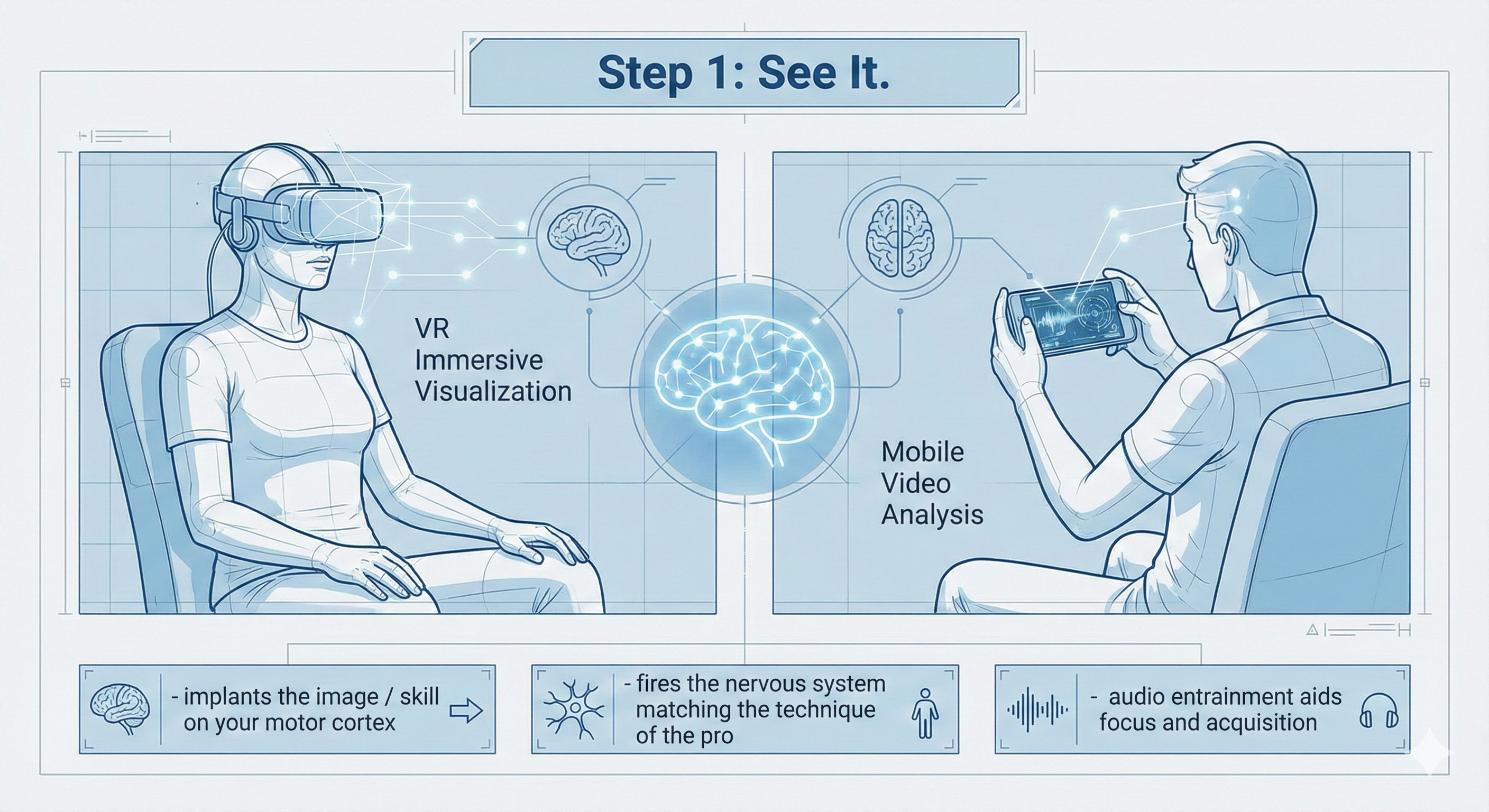
Step 1: See It — Observation Phase
Select an expert model — an elite hitter with a clean, sequenced swing — and watch them in slow motion repeatedly. Not once. Not five times. Thirty repetitions minimum per session. This is not about consciously analyzing what they're doing. It's about letting your mirror neuron system build the blueprint. Watch the hip initiation. Watch the shoulder lag. Watch the extension through contact. Let your brain absorb the pattern.
Step 2: Feel It — Physical Installation
After the observation phase, put on a blindfold or close your eyes and perform the swing in slow motion — matching the tempo of the expert footage you just watched. Eyes closed is critical. When vision is removed, your brain is forced to construct the movement from the internal blueprint — the neural model you just built. This is called sensory reweighting. Without visual input to fall back on, proprioception must take the lead, which is exactly how you want to execute the swing in a game: by feel, not by sight.
Step 3: Do It — Live Integration
Now perform at full speed. Don't think about it. The point is not to consciously remember "keep my shoulder in." The point is that the nervous system now has a cleaner blueprint installed. Execute, get feedback, repeat the protocol over days and weeks.
The physical installation phase with eyes closed forces your nervous system to build the movement from the inside out — from proprioception, not visual copying. This is the step that transfers the observed blueprint into your actual motor memory. Without it, you're still relying on conscious imitation, which doesn't survive live pitching.
Identifying Your Flaw First
Before you can fix flying open, you need to confirm that's actually what you're doing — and specifically when in the sequence it's happening. Is your shoulder rotating before your front foot lands? At foot strike? At heel plant? The timing of the leak determines the corrective emphasis.
This is where objective video analysis becomes essential. You cannot accurately self-diagnose a 150ms movement from memory. Frame-by-frame video allows you to see — and prove — exactly what your shoulder is doing relative to your hips at every phase of the swing.

Find Your Weakness. Fix It with a GOAT.
The GOAT Platform identifies your primary movement flaw and shows you side-by-side with an expert model at the exact phase where your sequence breaks down. No guessing. No subjective coaching. Objective, frame-by-frame proof — and the expert model your mirror neurons need to install the correct pattern.
Find Your Weakness →How Many Sessions Does It Take?
That depends on how deeply entrenched the pattern is. Mechanics ingrained over years of repetition have deep neural grooves. You're not erasing them — you're building a competing pathway that eventually wins more consistently. Most athletes begin to notice a difference within 5–10 focused sessions. Meaningful in-game integration typically takes 3–6 weeks of consistent protocol work.
The important point: you are not trying harder. You are training differently. The effort that goes into grinding out cage sessions with conscious "stay closed" cues produces diminishing returns once you've already isolated the problem. What produces new results is the neurological repetition — 30 slow-motion expert observations per session, followed by eyes-closed physical installation.
The Bottom Line
Flying open is not a mental weakness. It's not a strength deficit. It is an implicit motor memory running a flawed program — and the only way to replace an implicit program is to install a better one at the same implicit level.
Verbal coaching can help you understand what to do. Drills can isolate correct mechanics in slow environments. But what actually changes the pattern under pressure — in a live at-bat, on an 0-2 count — is a nervous system that has absorbed the correct blueprint deeply enough to run it automatically.
That's what the observation-based protocol is designed to do. Thirty slow-motion reps. Eyes closed. Slow motion. Repeat over weeks. That's the method that works at the neurological level where your swing actually lives.