
A late contact point is the single most common mechanical flaw at the club level in tennis. It doesn't look dramatic. It doesn't feel obviously wrong. And that's precisely why it persists for years — sometimes entire careers — without being fixed.
If your forehand is inconsistent, lacks power on balls hit to your dominant side, produces weak floaters on pace balls, or simply never feels "clean" no matter how much you practice, the contact point is almost certainly involved. This article breaks down exactly what a late contact point is, why it happens, why you probably can't feel it happening in real time, and what the research says actually fixes it.
Every other forehand fix — wrist position, follow-through, unit turn, footwork — becomes far easier once the contact point is correct. A late contact point forces compensations throughout the entire stroke. Fix the contact point and many other problems resolve on their own.
What "Late Contact" Actually Means
Contact point refers to the position of the ball — relative to your body — at the moment of impact with the strings. On a forehand, the optimal contact point is in front of your front hip, roughly at arm's length and slightly to the side of your body.
A late contact point means the ball has traveled past that optimal position before you make contact. Instead of striking the ball in front of your body where you can drive through it with full hip and shoulder rotation, you're making contact beside or even slightly behind your hip — where you have almost no rotational power available and where the racket face is naturally closing or opening at an angle that destroys consistency.
The ideal contact window is narrower than most players realize. At 60mph+ ball speed, it lasts less than 100 milliseconds.
The consequences of making contact late compound across every aspect of the stroke:
- Power loss — hip and shoulder rotation has already fired; the ball is absorbing the tail end of the kinetic chain rather than the peak
- Inconsistent direction — a closing racket face at late contact pushes the ball left; an open face sends it right. Small timing variations produce large directional errors
- Weak floaters under pressure — pace balls arrive faster, compressing the contact window; late contact becomes more severe exactly when it matters most
- Inability to generate topspin — proper topspin requires brushing up and through the ball in front of the body; from a late contact position, the swing path cannot produce the correct angle
Why It Happens: The Three Root Causes
1. Late Preparation — Unit Turn Timing
The most common cause is simply starting the unit turn too late. The unit turn — rotating the shoulders and hips together away from the net as the ball leaves your opponent's racket — is what positions your body to make contact in front of the hip. If you wait until the ball bounces to begin your preparation, you are already behind schedule. By the time the ball arrives at the contact zone, your body hasn't finished rotating and your racket is trailing your ideal contact point.
Elite players begin their unit turn the moment they read their opponent's shot — often before the ball crosses the net. The reaction time gap between elite and club players isn't primarily about physical speed. It's about when in the ball's flight the decision to move is made.
2. Watching the Bounce Instead of the Opponent's Contact
Many players track the ball to the bounce point before initiating movement. This is a full half-second of wasted preparation time on a 60mph shot. Elite players use a predictive model — they read spin, trajectory, and pace from the opponent's racket contact and begin positioning before the ball crosses the net. Waiting for the bounce to confirm direction means your preparation always starts too late.
3. The Implicit Motor Program Is Set to "Late"
This is the least discussed but most important cause. After years of making contact late — even slightly late — your nervous system has encoded that timing as the baseline. The motor program that fires when you execute a forehand has "late contact" built into it. You are not choosing to hit late. You are executing a stored pattern that happens to produce late contact.
This is why telling yourself to "hit earlier" rarely produces lasting change. The instruction goes to your conscious motor system. The forehand fires from your implicit motor system — fast, automatic, pattern-matched. By the time the ball arrives, the conscious instruction has been overridden by the stored program.
Why You Can't Feel It
Proprioception — your body's internal sense of position and movement — is surprisingly unreliable for diagnosing contact point problems. The reasons are neurological:
First, the forehand stroke takes approximately 250 milliseconds from racket drop to follow-through. Within that window, the conscious brain cannot receive, process, and act on proprioceptive feedback fast enough to make corrections. You are always responding to what happened, not what is happening.
Second, the nervous system uses efference copies — predicted sensory signals based on the motor command that was sent — to construct the feeling of a movement. This means what you "feel" during a forehand is partly a prediction, not a real-time report. When the motor program is set to late contact, the feeling of that late contact becomes the baseline. It feels normal because the system predicts it will feel normal.
You cannot reliably self-diagnose a contact point problem by feel. What feels late to you may be correct. What feels correct may be late. Only objective video analysis — frame-by-frame, with a reference point — gives you accurate information about where contact is actually occurring relative to your body.
Why Traditional Fixes Don't Hold
The standard advice for a late contact point: "Step into the ball earlier." "Get your racket back sooner." "Watch the ball all the way to the strings." All of these target the explicit motor system — the conscious, deliberate system that governs slow, thought-through movements.
In practice drills at half-pace with a cooperative partner feeding balls to the same spot, explicit coaching works. The player consciously applies the instruction, the contact point improves, the coach is satisfied. Then the player steps into a match, the ball comes at pace with spin and placement pressure, the implicit system takes over — and the old pattern returns.
This is not a mental weakness or lack of focus. It is the predictable result of training the wrong system. Game-speed forehands run on implicit motor memory. Explicit coaching only updates the explicit system. The transfer gap is real and it is why technically coached players "revert" under pressure — they are reverting to the implicit program that hasn't been updated.
The Fix: Updating the Implicit Pattern Through Observation
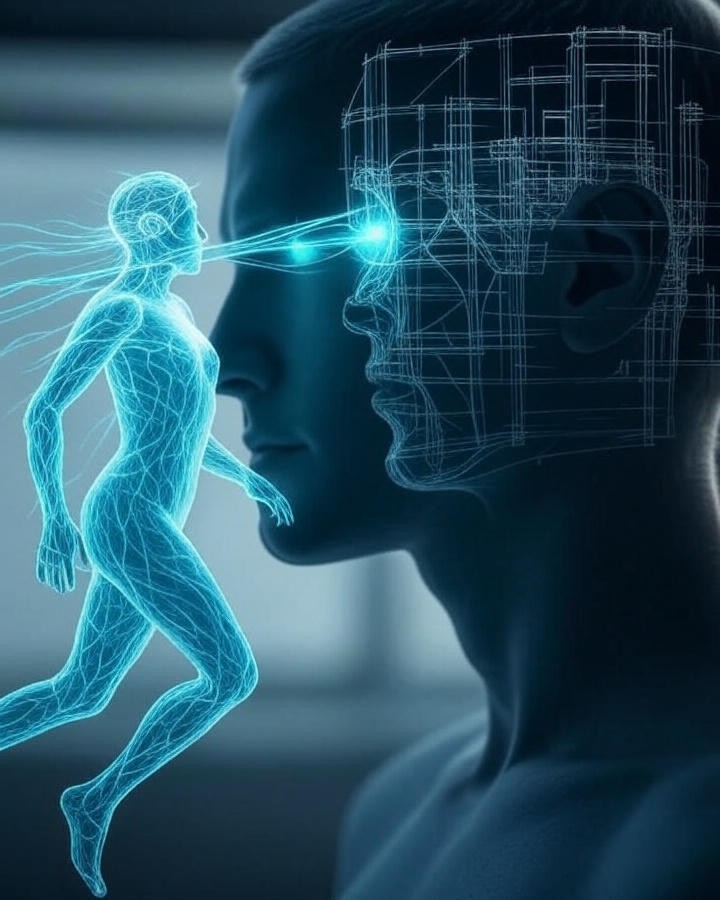
The mirror neuron system provides a direct pathway to updating implicit motor memory through observation. When you watch an elite player execute a forehand — specifically in slow motion — your motor cortex activates as if you are performing the movement. Repeated observation of the correct contact point timing builds a neural template that gradually competes with and replaces the stored late-contact pattern.
This is not passive watching. It is neurological practice. And three variables determine how effectively it transfers:
- Model quality: The player you observe must have genuinely correct contact point mechanics. Your mirror neurons encode what they see — an imprecise model produces an imprecise template.
- Slow motion: At full speed, the contact point moment is visually unresolvable. At 50% playback speed, the brain can parse exactly when the racket meets the ball relative to the player's hip position, encoding the correct timing relationship.
- Volume: A single observation produces a weak, transient neural activation. Thirty repetitions per session begins to build a durable competing template.
The Three-Step Protocol


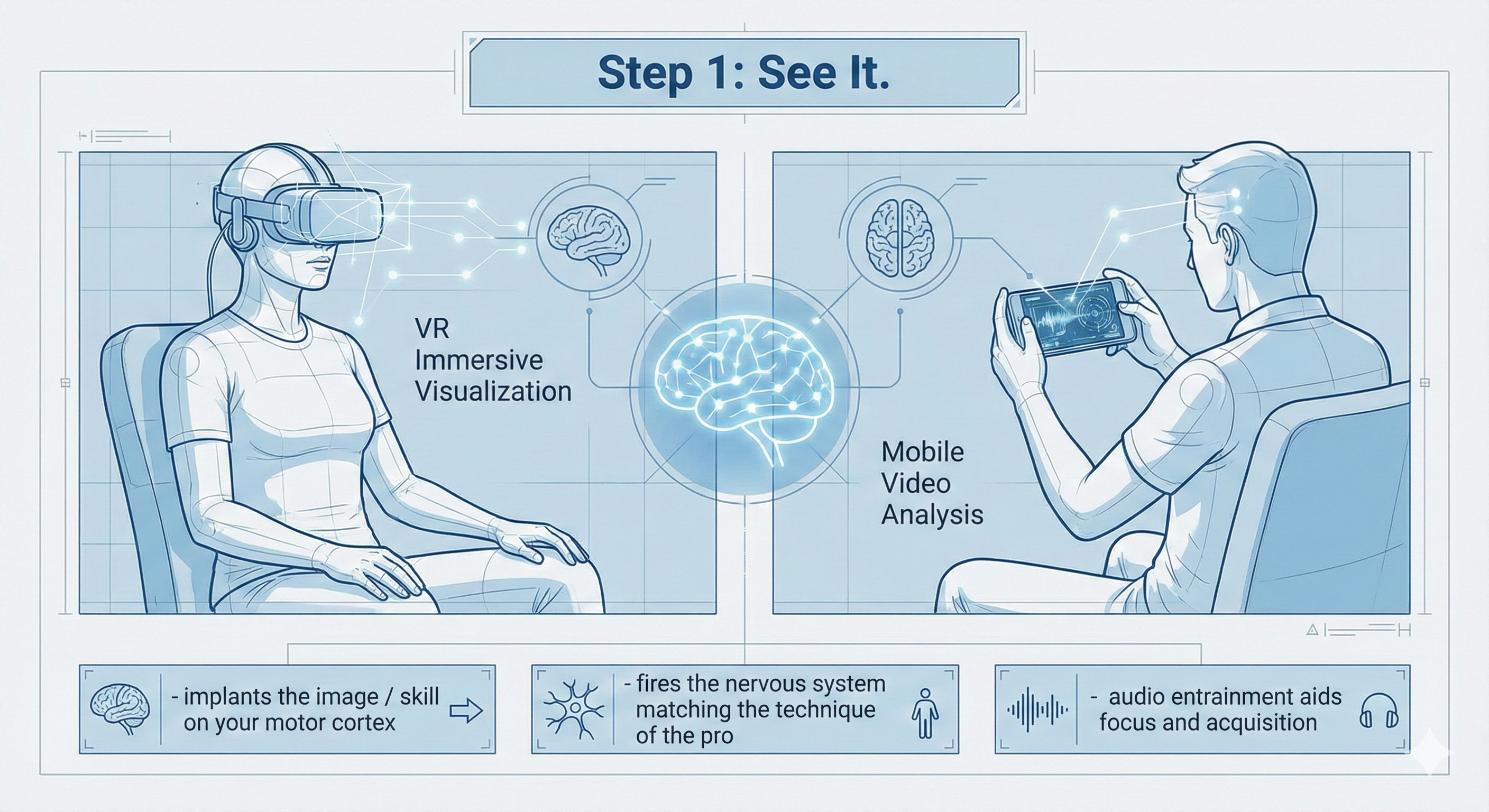
Step 1: See It — 30 Slow-Motion Observations
Select an elite player with clean forehand mechanics and a clearly visible early contact point. Watch the forehand in slow motion — specifically focus on the relationship between the ball and the player's front hip at contact. Not the follow-through. Not the footwork. The contact point moment. Watch it thirty times. Let your mirror neuron system build the template without consciously trying to analyze or memorize every detail.
Step 2: Feel It — Eyes-Closed Physical Installation
After observation, close your eyes and shadow swing — matching the tempo of the expert footage you just watched. Eyes closed is not optional. With vision removed, your brain cannot fall back on visual cues to guide the swing. It must construct the movement from the neural blueprint built during observation, cross-referencing it against proprioceptive signals. This is called sensory reweighting, and it is the step that installs the observed pattern as a felt motor memory rather than just a visual one.
Pay particular attention during this step to the feeling of your front hip clearing before the racket reaches contact. That relationship — hip first, then racket through — is what you are encoding.
Step 3: Do It — Live Integration
Now hit balls. Don't consciously try to apply the observation. Don't think "early contact." Let the nervous system run the updated program. The goal is not perfect execution immediately — it is giving the new template reps so it strengthens relative to the old pattern. Over days and weeks, the new template wins more consistently.
Most players notice a difference within 5–10 focused sessions. Consistent in-match integration typically takes 3–6 weeks of protocol work. The longer the late-contact pattern has been ingrained, the more reps the new template needs to establish dominance. This is not a quick fix — it is a neurological rewrite. But it holds, because it works at the level where the pattern actually lives.
Diagnosing the Exact Problem First
Before starting the protocol, you need to confirm that late contact is actually your primary problem — and identify specifically when in the sequence it occurs. Is your unit turn late? Are you watching the bounce instead of predicting? Is your racket preparation correct but your footwork putting you in the wrong position relative to the ball?
Frame-by-frame video analysis is the only reliable way to answer these questions objectively. The difference between a correct and late contact point is often a matter of inches — invisible to the naked eye at full speed, clear and measurable in slow-motion video with a reference point marked.

Find Your Weakness. Fix It with a GOAT.
The GOAT Platform identifies your primary movement flaw and places you side-by-side with an elite expert model at the exact phase where your mechanics break down. For tennis players, that means seeing your contact point timing against a pro's — frame by frame, at 50% speed. No guessing. Objective proof of the flaw. And the expert model your mirror neurons need to fix it.
Find Your Weakness →The Bottom Line
A late contact point is not a focus problem. It is not a laziness problem. It is an implicit motor program that has been reinforced over thousands of repetitions — and the only way to change an implicit program is to install a competing one at the same implicit level.
Thirty slow-motion observations of an elite forehand contact point. Eyes-closed physical execution. Repeated across weeks. That protocol works because it operates at the level where your forehand actually lives — below conscious thought, in the fast automatic system that fires every time the ball comes over the net.
Everything else — the unit turn cues, the "watch the ball" instructions, the step-in-early reminders — is useful context. But context doesn't change a motor pattern. Only neurological repetition does.