
You're not late. Your timing is probably fine. Most hitters who keep hitting grounders assume they're not seeing the ball well, or they're rushing, or they need more tee work. But if you're making contact — even hard contact — and it's consistently going into the ground, the problem is almost never timing. It's bat path.
Specifically, it's what happens to your top hand and wrists at the moment of contact. And because it happens in roughly 150 milliseconds, you almost certainly can't feel it doing it.
Top-hand rollover is the single most common cause of chronic grounders in baseball and softball. It produces downward bat path through the zone — the exact opposite of what contact with a pitched ball requires. Most hitters have been doing it for years and have no idea.
What Is Top-Hand Rollover?
Top-hand rollover happens when the top hand (right hand for right-handed hitters) rotates over the bottom hand too early — before or at the moment of contact, rather than after. The result is the barrel turning downward through the hitting zone instead of staying through it.
Picture the geometry: a pitch crosses the plate on a slightly downward trajectory (roughly 6–8 degrees, even on a "flat" fastball). To make square contact, you need the barrel travelling on a slightly upward path through the zone — matching the plane of the pitch. When your top hand rolls over early, the barrel drops through that zone at the wrong angle, making the bottom half of the ball the most common contact point. That's a grounder.
You'll recognize top-hand rollover by these consistent results:
- Grounders to the pull side, even on pitches you're "on"
- Weak topped balls that die in the infield
- Hard-hit balls that are on the ground instead of through the gaps
- Occasional opposite-field topspin grounders when you try to go the other way
- Line drives that feel solid but just "die" — low trajectory, no carry
The maddening part: you felt good on those swings. The contact wasn't terrible. You just keep putting it on the ground.
Why the Wrist Roll Happens
The wrist roll is not a flaw you developed from nowhere. In most cases, it developed as a compensation — or as the natural extension of a slightly different core flaw.
The casting problem
When a hitter casts the barrel — extends the hands away from the body early in the swing — the hands and barrel end up out in front of the body with the barrel still on the way down to the ball. The only way to redirect that barrel to contact is to roll the top hand over. The rollover is a symptom; casting is the root.
The extension-first habit
Many hitters were coached to "get extension" without proper sequencing. Extension through the ball is correct — extension before contact is the problem. When the arms extend before the barrel has reached the hitting zone, the top hand has to roll in order to redirect the barrel back to where the ball is.
Pure top-hand dominance
Some hitters are simply top-hand dominant in their grip and swing pattern. The top hand fires first and hardest, pulling the barrel through contact rather than pushing with the bottom hand. The result is premature rotation of the barrel.
These three causes look nearly identical at full speed — and they feel the same to the hitter. Frame-by-frame video is the only way to determine whether you're rolling because of casting, extension-first, or pure top-hand dominance. The correction is different for each cause.
Why You Can't Feel It
The wrist roll takes place in the final 50 milliseconds of the swing — the phase your nervous system cannot consciously monitor. By the time the barrel is entering the contact zone, the movement is being executed entirely by implicit motor memory, not conscious intent.
This is why telling yourself "don't roll" doesn't work. You already know not to roll. The conscious you agrees completely. But the implicit motor program — the one that actually runs the swing — hasn't received that update. It's still executing the version it's been running for years.
What makes this worse: your proprioceptive system — your body's internal sense of position and movement — tends to confirm what you expect to feel. If you've been rolling for years, that rollover pattern feels neutral to you. It doesn't register as wrong. Your brain has calibrated "normal" to include the flaw.
This is the core of why grounders persist even after years of practice. You are not making the same mistake because you're not trying. You are making the same mistake because your nervous system has encoded it as the correct pattern. The fix requires updating the program, not trying harder to override it.
The Fix: It Starts with Observation, Not Drills

Neurophysiologist Giacomo Rizzolatti's discovery of mirror neurons showed that the brain's motor system activates when observing skilled movement — not just when performing it. When you watch an elite hitter in slow motion, your premotor cortex is building a forward model of the movement. A neural blueprint of correct bat path through the zone, correct extension timing, correct wrist mechanics through contact.
The critical variable is slow motion. At full speed, you see "a swing." At 50% speed, your visual cortex can resolve the fine-grained mechanics — the barrel angle at contact, the relationship between the bottom hand driving and the top hand staying behind it, the extension through the ball before any rotation occurs. The brain needs this resolution to build an accurate blueprint.
The protocol is not complicated, but it requires consistency:


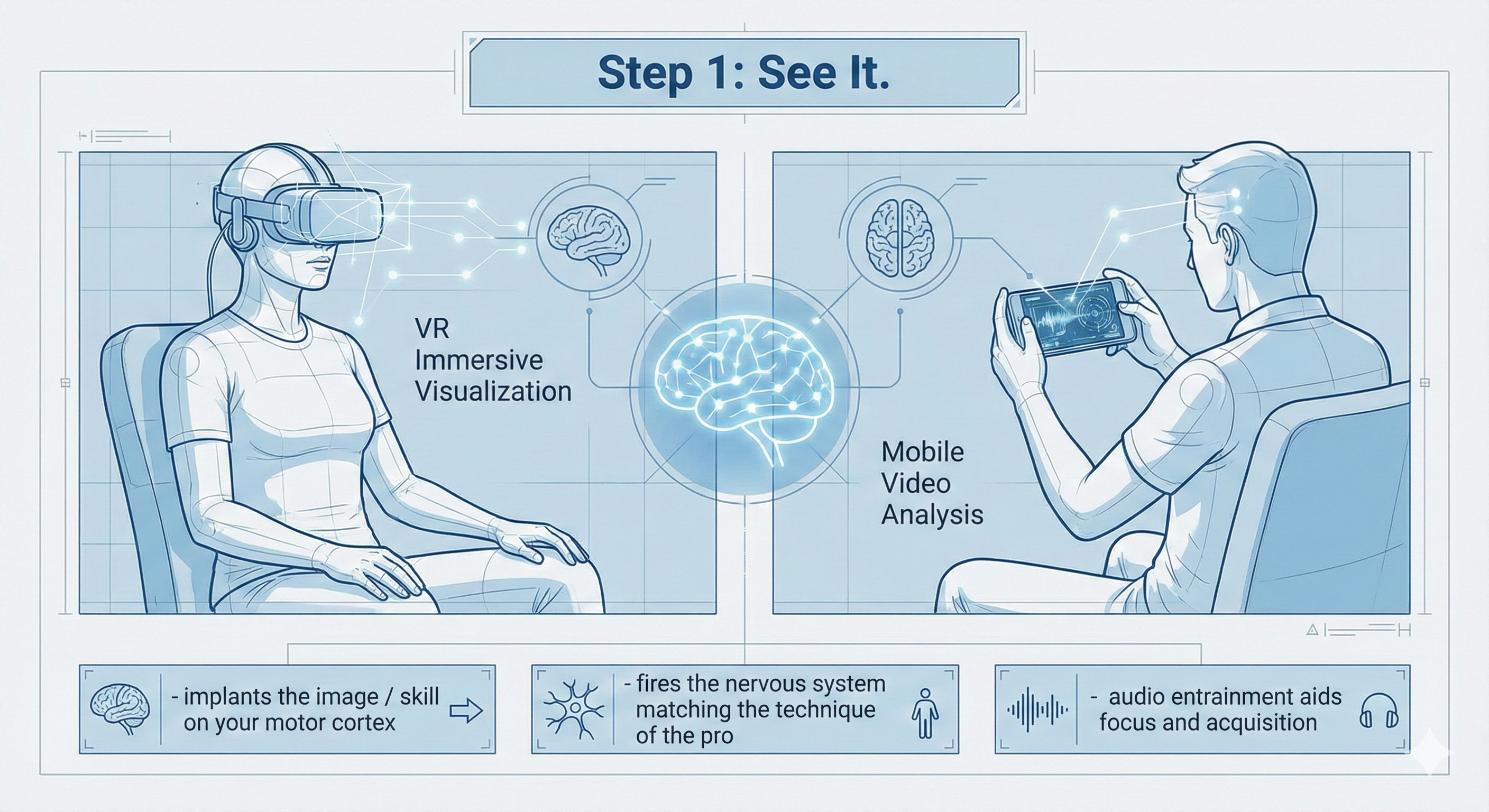
Step 1: See It — 30 Slow-Motion Observations
Select an elite hitter who keeps the barrel through the zone — who shows clear bottom-hand drive, proper extension before any top-hand rotation, and correct barrel angle at contact. Watch them in slow motion. Not 5 times. Not 10. Thirty repetitions per session. You are not analyzing. You are letting your mirror neuron system build the blueprint of what staying through the ball actually looks like at the mechanical level.
Step 2: Feel It — Eyes Closed, Slow Motion
Immediately after the observation phase, close your eyes and perform the swing in slow motion — matching the pace of the footage you just watched. Eyes closed is essential. Without visual input, your brain must construct the movement from the internal model you just built. This forces your proprioceptive system to recalibrate to the new blueprint — not the old flawed one. This is called sensory reweighting, and it is the step that actually transfers the correction into implicit motor memory.
Step 3: Do It — Full Speed, No Thought
Execute at full speed. Don't try to consciously control the wrist. Don't think "stay through the ball." The protocol has done its job. Your job now is to execute and observe results. Over repeated sessions, the nervous system routes through the new blueprint more consistently under live conditions.
The physical installation phase with eyes closed is what transfers the observed blueprint into motor memory. Without it, you've done useful film study — but you haven't installed anything. The change lives in the observation only. To move it into your implicit motor system, you have to execute it under internal guidance.
Identify the Root Cause First
Before running the protocol, confirm exactly where in your swing the rollover is occurring — and whether it's driven by casting, early extension, or top-hand dominance. This determines which expert model you select and which phase of the swing to focus on during observation.
Frame-by-frame video analysis is the only reliable way to do this. You cannot self-diagnose a 150ms movement accurately from feel or memory. You need the video evidence — ideally side-by-side with an expert model — to see exactly when the barrel starts turning and what triggered it.

See Exactly Where Your Bat Path Breaks Down
The GOAT Platform identifies your primary mechanical flaw — including top-hand rollover and bat path issues — and shows you side-by-side with an expert model at the exact phase where the problem occurs. No guessing. No subjective coaching. Objective, frame-by-frame proof — and the expert model your mirror neurons need to install the correct pattern.
Find Your Weakness →How Long Until You Stop Hitting Grounders?
Most hitters running the protocol correctly notice a difference within 5–10 sessions. Meaningful change in live at-bat results typically takes 3–6 weeks of consistent daily practice — not because the protocol is slow, but because the old motor pattern is deeply grooved and the new one needs enough repetitions to compete reliably under pressure.
The important mindset shift: you are not working harder. You are training the right system. Grinding tee sessions while consciously thinking "don't roll" is training your explicit motor system on a problem that lives in your implicit motor system. That's why the effort doesn't transfer. The protocol targets the implicit system directly — through observation and eyes-closed physical installation — which is where the swing actually runs from.
The Bottom Line
If you keep hitting grounders, there is almost certainly a specific mechanical flaw producing the downward bat path — most commonly top-hand rollover, and usually caused by casting or early extension upstream. It's not a timing problem. It's not effort. It's a program your nervous system is running automatically.
Verbal cues won't fix it. More tee work at full speed with the same pattern won't fix it. What fixes it is updating the implicit motor program — and the most direct way to do that is through structured observation of correct mechanics followed by eyes-closed physical installation.
Identify the flaw. Build the blueprint. Install it. Repeat over weeks. That's the sequence that produces line drives instead of grounders.