You've hit thousands of forehands. You know what a good one feels like. You can do it in warmup. You can do it in practice. And then, in a match — or even mid-rally — the same stroke that felt locked in starts misfiring. Into the net. Long. Down the middle when you needed cross-court. And it feels random.
It's not random. There is a specific mechanical reason your forehand is inconsistent. And the reason it's been hard to fix is that the flaw lives below the level of conscious awareness — in implicit motor memory — where your proprioceptive system can't detect it in real time.
Forehand inconsistency almost always traces to a single mechanical variable drifting under pressure — most commonly contact point position, low-to-high swing path discipline, or unit turn timing. The flaw doesn't feel wrong because your nervous system has calibrated "normal" to include it. That's what makes it so persistent.
Inconsistency Has One Root — Even When It Looks Like Many
Most players describe forehand inconsistency as a collection of problems: sometimes it goes long, sometimes into the net, sometimes the pace is missing, sometimes the direction is off. It feels like a different issue each time.
But in the vast majority of cases, these are symptoms of a single upstream flaw — a variable that drifts, and whose drift produces different outcomes depending on the ball's height, pace, spin, and your court position at the moment of contact. One small change in the contact point creates a long ball. A slightly different arm position produces a net error. The same flaw, expressed differently.
The three most common root flaws:
- Contact point drift — the ball is not meeting the racket face at a consistent position relative to your body. When the contact point is too close, you lose power and direction. When it's too far out front, you lose topspin and control.
- Swing path inconsistency — the racket is not reliably traveling low-to-high through the contact zone. Any deviation from the plane — catching the ball on the way down, on the way too steeply up — produces unpredictable spin and trajectory.
- Incomplete or inconsistent unit turn — the coil from which all forehand power derives. When the unit turn doesn't complete fully, the swing compensates with arm-only mechanics, producing shots that feel "armsy," inconsistent in pace, and unreliable on the wide ball.
One flaw produces different errors depending on the incoming ball. A drifting contact point gives you different misses on a high ball vs. a low ball vs. a wide ball. It looks like multiple problems. It's one problem interacting with different inputs.
Why You Can't Fix It by Focusing Harder
The forehand swing takes roughly 300–400 milliseconds from initiation to contact — and the contact phase itself lasts under 5 milliseconds. The window in which your nervous system can consciously adjust mid-swing is essentially zero.
This is the fundamental problem with the most common advice: "watch the ball more closely," "extend through the ball," "get your racket back earlier." These cues address the explicit motor system — the slow, conscious, deliberate system you use when learning a new pattern. But your forehand doesn't run from the explicit system. It runs from implicit motor memory — the fast, automatic pattern-matching system that fires before you can think.
This creates a specific trap: you can execute a technically correct forehand when you're thinking about it consciously — on a feed, at slow pace, in isolation. The moment a live ball arrives at match pace with directional pressure, the explicit system steps back and the implicit system takes over. And the implicit system runs the old pattern — the one with the flaw encoded in it.
The flaw isn't a concentration failure. It's a software problem. The program running your forehand has an error in it — and you cannot fix a software error by trying harder to run the software.
The Role of Proprioception in Forehand Inconsistency
Proprioception is your body's internal sense of position and movement — the system that tells you where your arm is, how fast the racket is moving, and what angle the face is at, without needing to look. It's what allows you to swing without watching your racket.
The problem: proprioception is not objective. It recalibrates to whatever pattern you've been running. If you've been making contact 6 inches closer to your body than optimal for the past two years, that position feels neutral. It doesn't feel wrong. Your nervous system has registered "this is where my forehand is" — and it's off.
When coaches give you feedback — "you're making contact too close" — and you try to make the adjustment, it often feels awkward and overcorrected, even when it's exactly right. Your proprioceptive baseline is lying to you. You adjust, it doesn't feel right, you drift back toward what feels normal. Which is the flawed position.

This is why the fix can't be just verbal correction or drill work. You need to recalibrate the proprioceptive baseline itself — the internal reference point your nervous system uses to know what "correct" feels like. And that requires a different approach entirely.
The Neuroscience Behind the Fix: Mirror Neurons and Motor Blueprints
In the 1990s, researchers studying the premotor cortex discovered a class of neurons — now called mirror neurons — that fire both when you execute a movement and when you observe someone else execute it. When you watch an expert tennis player hit a technically correct forehand, your brain's motor system is not passive. It is actively building a forward model — a neural blueprint — of that movement.
What this means for forehand inconsistency: correct observation is a form of training. The blueprint your mirror neuron system builds during focused observation of an elite forehand is a direct competitor to the flawed blueprint currently stored in your motor memory. With enough repetitions under the right conditions, the correct blueprint gains enough strength to run more reliably — even under match pressure.
The key condition is slow motion. At full speed, the brain processes the forehand as a single gesture — and often fills in details based on expectation. At 50% speed, the visual cortex can resolve the fine mechanics: the low-to-high path of the racket, the extension through the contact zone, the relationship between shoulder rotation and arm extension, the correct contact point position relative to the body. This is the resolution your mirror neuron system needs to build an accurate blueprint.
The Three-Step Protocol: See It, Feel It, Do It
The GOAT method applies this mechanism in a structured, repeatable protocol. The three steps are sequential — compressing or skipping any step reduces the transfer to your actual motor pattern.


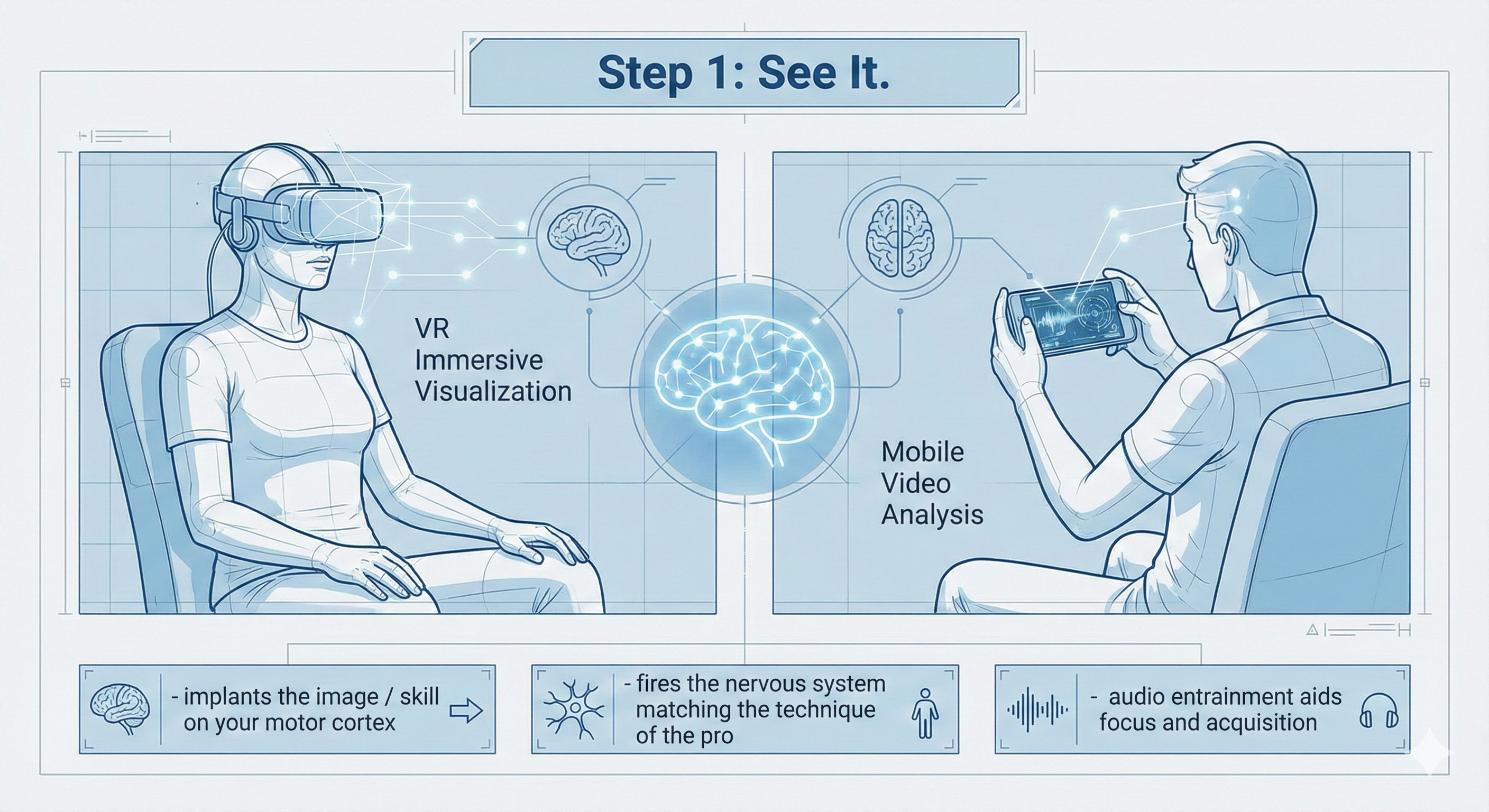
Step 1: See It — 30 Slow-Motion Observations
Select an expert model with a technically clean forehand — clean unit turn, consistent contact point, clear low-to-high path, extension through the ball. Watch them in slow motion. Thirty repetitions minimum per session. You are not analyzing. You are not consciously cataloguing each element. You are letting your mirror neuron system encode the pattern — building a competing blueprint at the neural level. The detail and repetition matter. A few casual observations at full speed will not do it.
Step 2: Feel It — Eyes Closed, Slow Motion
Immediately after the observation phase, close your eyes and execute the forehand in slow motion — matching the tempo of the expert footage you just watched. The blindfold is non-negotiable. Without visual input, your brain must construct the movement entirely from the internal model — the blueprint you just built through observation. This forces proprioceptive recalibration: your nervous system has to figure out what "correct" feels like using the new blueprint as its reference, not the old flawed one. This step is what transfers the observation into motor memory. Without it, you've done useful film study but installed nothing.
Step 3: Do It — Full Speed, No Overthinking
Execute at full speed without conscious cues. Don't try to remember what you observed. Don't try to consciously correct the contact point. The protocol has done the work. Your job is to execute and observe the output. Over repeated sessions, the new blueprint competes more reliably with the old one — and the inconsistency reduces.
When the eyes-closed slow-motion reps feel different from your normal forehand — awkward, off-balance, "not right" — that's evidence the new blueprint is diverging from the flawed baseline. Don't interpret that feeling as "I'm doing it wrong." It means you're installing a different pattern. Stay with it.
Identifying Your Specific Flaw First
Before starting the protocol, you need to know which of the three upstream flaws is producing your inconsistency — contact point drift, swing path deviation, or unit turn breakdown. The correction emphasis during observation is different for each.
You cannot accurately self-diagnose this. Your proprioceptive baseline is off by definition — that's the problem. You need frame-by-frame video of your forehand, ideally side-by-side with an expert model at the same contact phase. This is the only objective way to see where your mechanics diverge from the correct pattern, and when in the swing the divergence occurs.

Find the One Flaw Making Your Forehand Inconsistent
The GOAT Platform identifies your primary forehand mechanics flaw and shows you side-by-side with an expert model at the exact phase where your stroke diverges. No guessing. No subjective coaching. Objective, frame-by-frame proof — plus the expert model your mirror neurons need to start building the correct blueprint.
Find Your Weakness →How Long Until the Forehand Gets Consistent?
Most players running the protocol correctly — 30 slow-motion observations plus eyes-closed installation daily — notice a change in practice within 1–2 weeks. Match-pressure consistency takes longer: typically 3–6 weeks, because the old pattern is more deeply grooved under stress, and the new blueprint needs more repetitions to be the dominant one when arousal is high.
The key variable is not effort — it is repetition quality and protocol adherence. Grinding extra forehands at full speed while hoping the problem self-corrects is not going to recalibrate a proprioceptive baseline that has been off for years. What changes it is consistent daily installation of the correct blueprint at the implicit level, through the observation and eyes-closed protocol, repeated across weeks.
The Bottom Line
A consistent tennis forehand is not a matter of concentration. It is not a matter of effort or match experience. It is a matter of whether the implicit motor program running your forehand is the correct one — and whether your proprioceptive system's baseline accurately reflects what "right" feels like.
If your forehand is inconsistent, the program has an error. Your proprioceptive baseline has drifted. You can't think your way out of either of those problems — because neither of them is accessible to the thinking brain during a rally.
What you can do is identify the specific mechanical flaw through objective video analysis, select the right expert model, and run the observation-installation protocol consistently over weeks. That is the path to a forehand that holds up when it counts — not because you're trying harder, but because the pattern your nervous system is running is finally the right one.