There is a coaching instruction as old as sport itself: watch the best and copy what they do. For generations, this was treated as folk wisdom — useful but unscientific. What we now know is that this instruction is not just practical. It is neurologically precise.
When an athlete watches an expert perform a movement, their brain does not simply record what it sees. The motor cortex activates. The same neural circuits responsible for executing the movement begin firing as if the athlete were performing it themselves. The body, from a neurological standpoint, is practicing — without moving.
This is the mirror neuron system. And understanding it changes how you coach, how you train, and how you think about the relationship between observation and performance.
Every sport-specific fix on this platform — baseball swing mechanics, tennis stroke correction, movement pattern retraining — works because of the mechanism described in this article. Read this first. Apply it to everything else.
The Discovery That Changed Motor Learning
In the early 1990s, a neuroscience team at the University of Parma led by Giacomo Rizzolatti was mapping the premotor cortex of macaque monkeys — the brain region responsible for planning movement. They had identified neurons that fired when a monkey reached for an object. Routine work.
Then, on an ordinary afternoon, a researcher walked into the lab holding an ice cream cone and raised it to his mouth. The monitoring equipment crackled. The monkey's premotor neurons — the ones mapped to its own reaching behavior — were firing. The monkey hadn't moved. It was simply watching.
After rigorous testing to rule out equipment error, the conclusion held: they had discovered neurons that fired both when an action was performed and when the same action was observed. They named them mirror neurons.
What started as a finding in macaques has since been extensively studied in humans through neuroimaging. The human mirror neuron system is more sophisticated and distributed than in any other species — spanning the premotor cortex, the inferior frontal gyrus, and the superior temporal sulcus. It is, in neuroscientist V.S. Ramachandran's phrase, the system that allowed human culture to spread like "a benevolent virus" — because we could learn by watching, not just by doing.
What "Motor Resonance" Means for Coaching
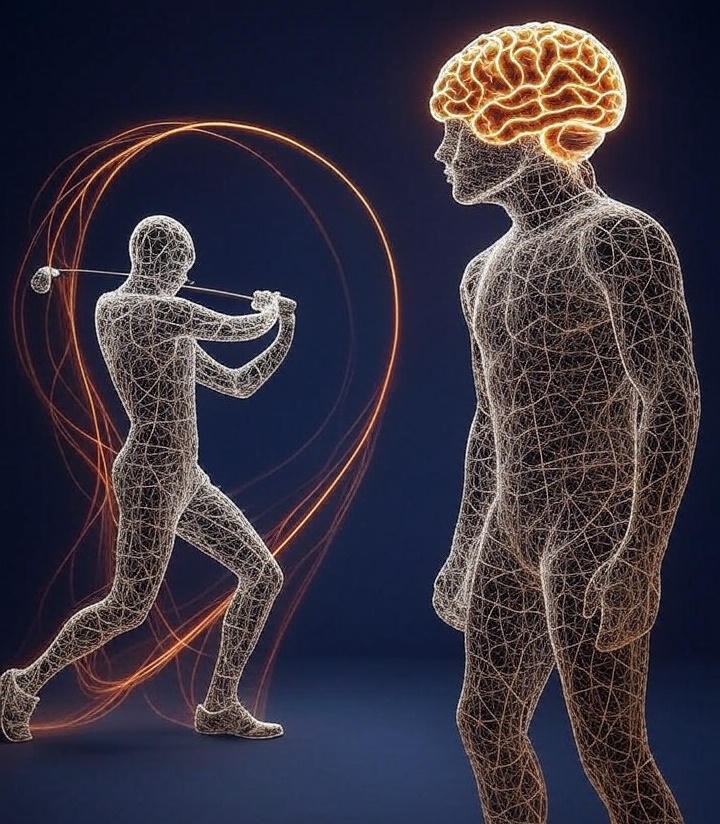
The technical term for what happens when you observe skilled movement is motor resonance — the brain's motor system "resonates" with the observed action, building an internal simulation of it. This simulation is not abstract. It is encoded in the same neural pathways that would fire during physical execution.
For coaches and athletes, this has four direct implications:
Observation is Physical Practice
Watching an expert doesn't just give you information. It physically activates your motor system. Repeated observation builds a neural template of the correct movement pattern.
Quality of the Model Matters Enormously
Your mirror neurons encode what they observe. If the model has flawed mechanics, you encode flawed mechanics. Elite models produce elite templates.
Slow Motion Amplifies the Effect
At full speed, fine-grained kinematic details compress and blur. Slow motion allows the visual cortex to resolve the precise sequence of body segment activation — producing a richer, more complete neural blueprint.
Attention Determines Transfer
Passive watching produces weak resonance. Focused, attentive observation — watching with intent to encode — produces significantly stronger motor activation and better transfer to performance.
Why Verbal Coaching Has a Hard Ceiling
Traditional coaching is explicit: "Rotate your hips first." "Keep your elbow up." "Stay on top of the ball." These are instructions delivered to the conscious motor system — the slow, deliberate, language-mediated system that governs new, unfamiliar movements.
The problem is that sport, at competitive speed, does not run on the explicit system. A baseball swing executes in under 150 milliseconds. A tennis serve fires in 250ms. A soccer player's first touch lasts less than 100ms. These movements run on implicit motor memory — fast, automatic, pattern-matched programs that the conscious mind cannot access in real time.
When you tell a player to "stay closed" during a batting slump, you are giving an instruction to the explicit system. They will execute it correctly in a slow drill. Then a pitcher throws a 90mph fastball, the implicit system takes over, and the old pattern fires. The verbal instruction doesn't survive the transition to game speed.
Explicit coaching (verbal cues, conscious drill focus) trains the slow, deliberate motor system. Games run on the fast, automatic implicit system. The two systems are neurologically distinct. Training one does not automatically update the other. This is why technically sound players "revert" under pressure — they are reverting to the implicit program that hasn't been updated.
Mirror neuron-based observation training works at the implicit level. Repeated, focused watching of an expert model — especially in slow motion — builds and reinforces the implicit template directly, without passing through the verbal-cognitive bottleneck. This is why it transfers to game performance in ways that verbal cues do not.
The Three Conditions That Maximize the Effect
Not all observation produces equal neurological benefit. Research on observational motor learning identifies three variables that determine how powerfully mirror neuron activation transfers to actual performance:
1. Model Quality — Elite, Not Average
The mirror neuron system encodes what it sees. The neural template built from watching an amateur with compensatory mechanics is fundamentally different from the template built by watching an elite athlete with clean, efficient movement. For technique correction, the model must be genuinely elite — someone whose mechanics you want to replicate, not just approximate.
2. Repetition Volume — 30 Observations Minimum
Single exposures to a correct movement pattern produce weak, transient neural activation. The motor template strengthens with repetition — the same principle that governs physical practice. Research protocols in observational motor learning consistently use 20–30 observation repetitions per session to produce measurable changes in subsequent movement quality. Watching once is not watching. Watching thirty times is training.
3. Playback Speed — Slow Motion is Not Optional
At game speed, the temporal resolution of a baseball swing or a tennis forehand is insufficient for the visual system to parse the kinematic sequence. The sequence matters: hip rotation initiating before shoulder rotation, shoulder lag creating torque, distal segments accelerating last. At 50% playback speed, these sequential relationships become visible and encodable. Slow motion does not just make the movement easier to see — it produces stronger motor cortex activation because the brain can build a more complete and accurate blueprint.
The Physical Installation Step: Why Blindfold Training Completes the Loop
Observation builds the template. But observation alone leaves one gap: the template exists as a visual-motor blueprint, but the athlete still needs to install it as a proprioceptive program — a felt, embodied sense of the movement, not just a seen one.
This is where sensory reweighting becomes the critical bridge. When vision is removed — blindfold, eyes closed — the brain cannot fall back on visual feedback to guide movement. It must construct the movement from internal proprioceptive signals, cross-referenced against the neural blueprint built during observation. The result is a movement executed from the inside out: built from feel, not from copying what you see in a mirror or on video.
This is precisely how elite movement is executed in competition. You do not watch your swing happen. You feel it. The blindfold phase of training forces the nervous system to build that felt sense, which is the version that survives game-speed execution.
The complete protocol — observation first, then eyes-closed physical execution — is what the GOAT platform is built around. It is not a coaching philosophy. It is a direct application of the neuroscience of motor learning.
Applied to Your Sport
The mirror neuron mechanism is sport-agnostic. The same principles apply whether the movement is a baseball swing, a tennis forehand, a serve, a pitching delivery, or a golf stroke. The specific mechanics differ. The neurological method is identical.
What This Means for How You Coach
If you coach athletes, the mirror neuron research points to a direct shift in how you structure sessions:
- Lead with observation, not instruction. Before a player attempts a corrected movement, show them the correct version — slowly, repeatedly. Let the neural template form before asking the body to execute.
- Use the best available model. That means elite footage, not average-quality demonstrations. The quality of what your athletes observe is as important as the quality of their physical practice.
- Prescription: 30 slow-motion observations before physical repetition. Not one or two. Thirty. This is not excessive — it is what the research supports for meaningful template formation.
- Follow observation with eyes-closed physical execution. This closes the loop between visual template and proprioceptive program. It is the step that transfers to game performance.
- Reduce verbal cuing during the observation phase. Talking over the video activates the explicit cognitive system and interrupts the implicit encoding process. Silence during observation is not wasted time — it is training.

The Platform Built on This Science
The GOAT Platform identifies your primary movement flaw, then shows you side-by-side with an elite expert model at 50% speed — exactly the conditions the mirror neuron research supports. Thirty observations. Expert models. Slow motion. Then the blindfold installation step. This is the method, built into a tool.
Find Your Weakness →The Bottom Line
Observation-based learning is not a hack or a shortcut. It is a description of how the human motor system actually acquires skills. The mirror neuron system exists precisely because learning by watching is a core feature of human neurobiology — not a supplementary one.
The question is not whether to use it. Athletes and coaches have been using it instinctively for as long as sport has existed. The question is whether to use it systematically — with the right model quality, the right volume of observation, the right playback speed, and the right follow-through to proprioceptive installation.
When you do, you are not just adding a training tool. You are engaging the most powerful motor learning mechanism the human nervous system has. Everything else — the drills, the reps, the coaching cues — works better on top of a well-encoded neural blueprint. This is where that blueprint comes from.